
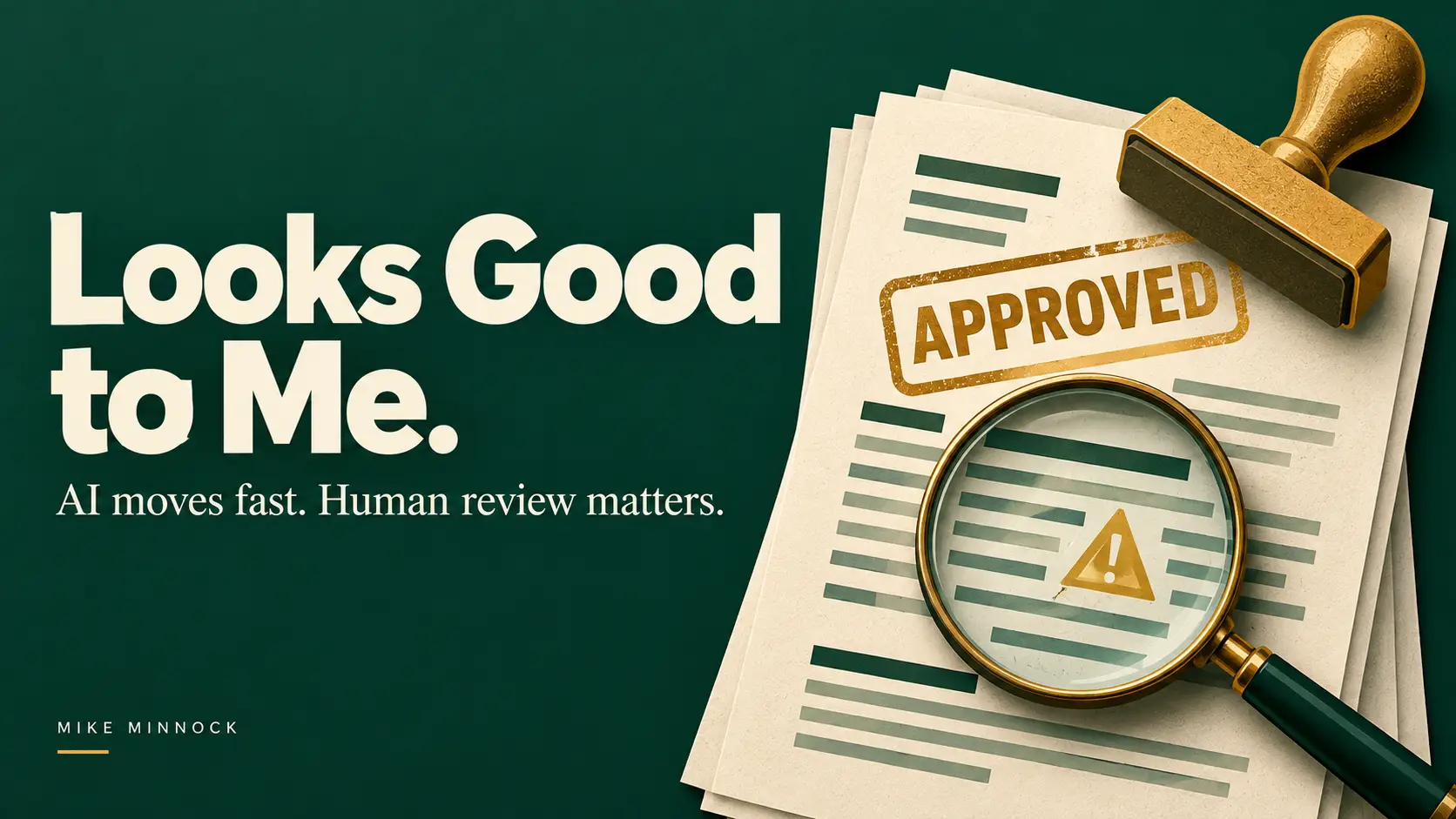
In software, there’s a short phrase engineers type when they approve someone else’s code: LGTM, short for “looks good to me.” It’s supposed to mean “I read this, and it’s ready.” A new satirical music video points out that lately, it often means something else.
The video is called “LGTM (Looks Good to Me),” and it was posted in October 2026 by a channel called Degenerative Pixels. It’s funny, it’s a little uncomfortable, and I think it says something every small business owner using AI should hear.
What the video is getting at
The premise is simple. People are typing “looks good to me” on AI-written work they never actually had time to read. Why? Because leadership heard that AI makes everyone ten times faster and cut deadlines to match. When the schedule gets squeezed, review and testing are the first things to go.
My favorite part is the credits, which joke: “Reviewed by: BOT-001 (1,363 reviewers, 0 humans). Actually reviewed by: 1 human.” That line pretty much sums up the whole thing.
Here’s the twist that keeps it from being an anti-AI rant: the animation itself was made with an AI model. That’s part of the point. The tools really are powerful. The video isn’t saying “don’t use them.” It’s saying don’t stop paying attention just because they’re good.
The small business version of “looks good to me”
Most of the business owners I talk to aren’t shipping software. But the same pattern shows up in marketing, and it shows up quietly.
It looks like this:
- An AI tool drafts your monthly email, you skim the first line, and you hit send.
- You ask for new website copy for your services page, it reads smoothly, and it goes live.
- Your ad platform suggests headlines and you accept all of them.
- A tool writes replies to your Google reviews and posts them automatically.
- You schedule a week of social posts in ten minutes and never look at them again.
None of that is a disaster on its own. AI drafts are often pretty good. The problem is the gap between “this reads well” and “this is true, this sounds like you, and I’d be comfortable if a customer asked me about it.” Smooth writing isn’t the same as correct writing, and it definitely isn’t the same as your writing.
When something goes wrong in a small business, there’s no BOT-001 to blame. It’s your name on the email and your business on the review reply.
How I handle it in my own work
I’ll be upfront: I use AI every day. I use it to draft, to research, to outline, to rework something that’s running long, and to get past a blank page. It saves me real time.
And I still read and approve everything myself before it goes out. Not a skim. An actual read. That’s the step I don’t let a deadline take away, because it’s the step where I catch the things that matter: a detail that isn’t right, a sentence that doesn’t sound like me, or a promise I wouldn’t make.
Where a human should always look
You don’t need to review everything with the same intensity. But some things should never go out without a real person reading them first. Here’s my short list:
- Anything with facts about your business. Hours, prices, service areas, phone numbers, what’s included and what isn’t. AI will fill gaps with something that sounds right.
- Anything that makes a promise. Turnaround times, results, “best in Pittsburgh” style claims, offers and promotions. If you wouldn’t say it to a customer’s face, it shouldn’t be in your copy.
- Replies to customers, especially reviews. A generic or slightly off reply to an unhappy customer can do more harm than no reply. These are public and they’re personal.
- Your homepage and key service pages. This is where people decide whether to call you. It needs to sound like you, not like everyone else using the same tool.
- Anything in a sensitive area. Health, money, housing, legal matters or anything where a wrong word could mislead someone or land you in trouble. Read it slowly.
- Anything going to your whole list at once. One email to a few thousand people is one mistake multiplied by a few thousand.
Where it’s fine to lean on AI for speed
This is the part people sometimes miss. Being careful doesn’t mean being slow everywhere. There’s plenty of work where AI can carry most of the load:
- First drafts. Let it get you from nothing to something. You’ll edit from there.
- Brainstorming. Headline options, post ideas, subject lines, different ways to explain a service. Ask for twenty and keep two.
- Summarizing. Long meeting notes, a stack of customer feedback, a report you need the gist of.
- Reformatting and resizing. Turning a blog post into a few social captions, or cutting a paragraph down to fit an ad.
- Outlines and structure. Getting the order of a page or a presentation roughed out.
- Internal work. Checklists, process notes and drafts that only your team will see.
Even here, I’d still glance at the output. But the stakes are lower, and that’s where the time savings really add up.
A review step that fits a real week
The reason review gets cut is that it feels like extra time nobody has. So keep it small and make it a habit:
- Read it out loud. If it doesn’t sound like something you’d say, change it.
- Check every fact. Names, numbers, dates, prices, links. Click the links.
- Ask “would I stand behind this?” If a customer quoted it back to you, would you be fine with that?
- Turn off auto-posting for anything customer-facing. Drafts are great. Automatic publishing to the public is where things slip through.
- Put one named person on it. Not “the team.” One human who actually reads it, like the credits joke in the video.
For most small businesses, that’s a few minutes per piece. It’s a lot cheaper than cleaning up a public mistake.
The tools are good. Read anyway.
What I like about the LGTM video is that it doesn’t pretend AI is useless. It just points out, with a good sense of humor, what happens when we let speed push out the one step that keeps the work honest.
For small business marketing, that step is you or someone you trust actually reading the thing before it goes out. Use the tools. Let them save you hours. Just make sure that when you think “looks good to me,” you’ve actually looked.
If you’re figuring out where AI fits in your marketing or your day-to-day workflow, and where a human should stay in the loop, I’m always happy to talk it through. Let’s connect.